
Resilience
In this context, resilience is understood as the ability to deal with stressful events in a structured and effective manner. This includes preparing for potential events, limiting their impacts, responding appropriately while they are occurring, and subsequently restoring and further developing systems.
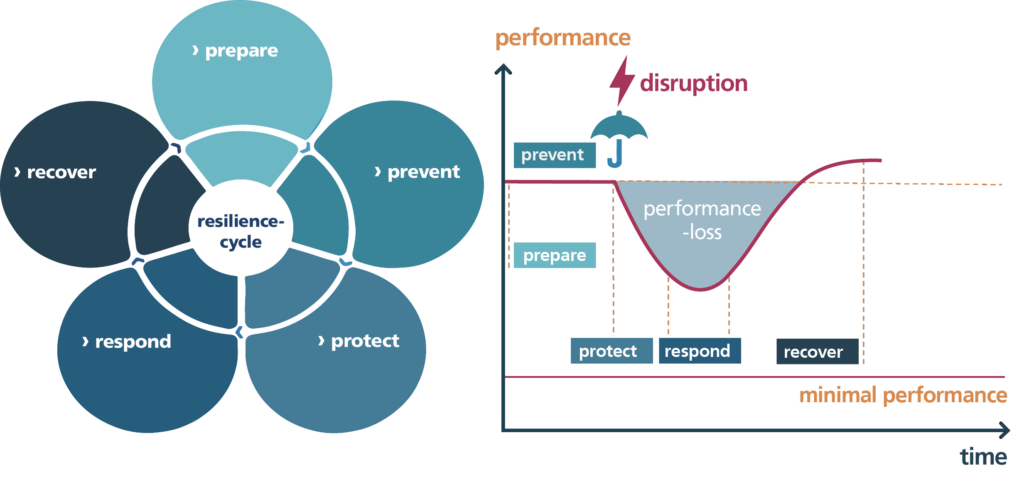
The resilience concept is divided into five cyclical phases: Prepare, Prevent, Protect, Respond, and Recover. These phases structure the temporal approach to dealing with disruptive events:
- Before the event: preparation and prevention
- During the event: protection and response
- After the event: recovery and adaptation
Adverse events are understood as natural, technical, or human-induced impacts with potentially severe consequences, for example in connection with climate change.
The tool presented systematically records the individual resilience phases and evaluates them with regard to the climate resilience of buildings. In doing so, it considers relevant performance characteristics over time, such as a building’s serviceability.
This temporal perspective makes it possible not only to describe resilience qualitatively, but also to evaluate it comparatively. It expands classical risk analyses and allows measures to increase resilience—such as robustness, redundancy, or additional resources—to be assessed in a targeted way with respect to their effectiveness and efficiency.